


Whether you're just getting started with your affiliate program, or you're focusing on a new affiliate recruitment push now, this is the article you should read right now.
Because the big secret that top brands already know: the best affiliates to recruit are the ones already promoting your competitors.
These affiliates already understand your niche. They've built audiences that care about products like yours. And they know how to create content that converts.
They're the quickest wins most brands haven't done enough of in their program — and they're the first place you should start for affiliate growth.
The only tricky part: finding them.
I've been running affiliate programs for dozens of clients for the last 7 years, as well as growing partner programs for my own brands including Endorsely, Answer Socrates, and AffiliateFinder.ai.
And in this guide, I'll walk you through 10 great ways you can discover exactly which affiliates are promoting your competitors…
As well as some tricks to cut the time from 15-20 hours, to around 10 minutes.
Here are the 10 ways to find all the affiliates actively promoting your competitors:
- Use a dedicated affiliate discovery tool like AffiliateFinder.ai
- Search Google for competitor review terms
- Find competitor backlinks using SEO tools
- Find YouTube competitor affiliates with these two tricks
- Monitor social media mentions of competitors
- Use referral traffic analysis tools
- Use affiliate networks directly to find competitor affiliates
- Reverse-engineer paid ads to find media buyer affiliates
- Lurk in niche-specific forums and affiliate groups
- Set up Google Alerts for competitor mentions
I'm also going to include the specific email templates that work best, and my recommendations of where to start so you have the maximum new affiliates + revenue generated in the next 30 days.
And, which of these methods are best for finding each type of affiliate (content websites, YouTubers, TikTok shop affiliates, paid ads affiliates, and more).
Why Finding Competitors' Affiliates is Worth Your Time
Affiliates that already promote your competitors are pre-qualified.
- They understand your market. They know the pain points, the objections, and what makes people buy.
- They have relevant audiences. Their followers already care about products like yours.
- They know how to convert. They've figured out what content formats and messaging work.
- They're actively creating content. You're not hoping they'll start — they already are.
Plus, while doing this research, you'll better understand your competitors' affiliate strategy, and will almost certainly surface new ideas to use yourself.
10 Ways to Find Your Competitors' Affiliates
1. Use a Dedicated Affiliate Discovery Tool: AffiliateFinder.ai
If you want to cut the 15-20 hour manual research process, you can use tools like AffiliateFinder.ai to instantly see the affiliates promoting your competitors.
These affiliate discovery tools scan multiple platforms (blogs, YouTube, TikTok, Instagram, podcasts) to find all the relevant affiliates and influencers for you.
Of course, I'm writing this on the AffiliateFinder blog, so I'm biased.
But according to many affiliate marketing experts including Matt McWilliams, AffiliateFinder is the best competitor affiliate discovery tool on the market.

How it works:
- You sign up for the 7-day free trial
- Enter your top 5 competitors, and main keywords
- AffiliateFinder finds all the affiliates + influencers talking about your competitors
- You can filter for each specific competitor, and by traffic, by channel (websites, YouTube, TikTok) to find the specific affiliates you want to reach out to

AffiliateFinder finds around 91% of verified contact details.

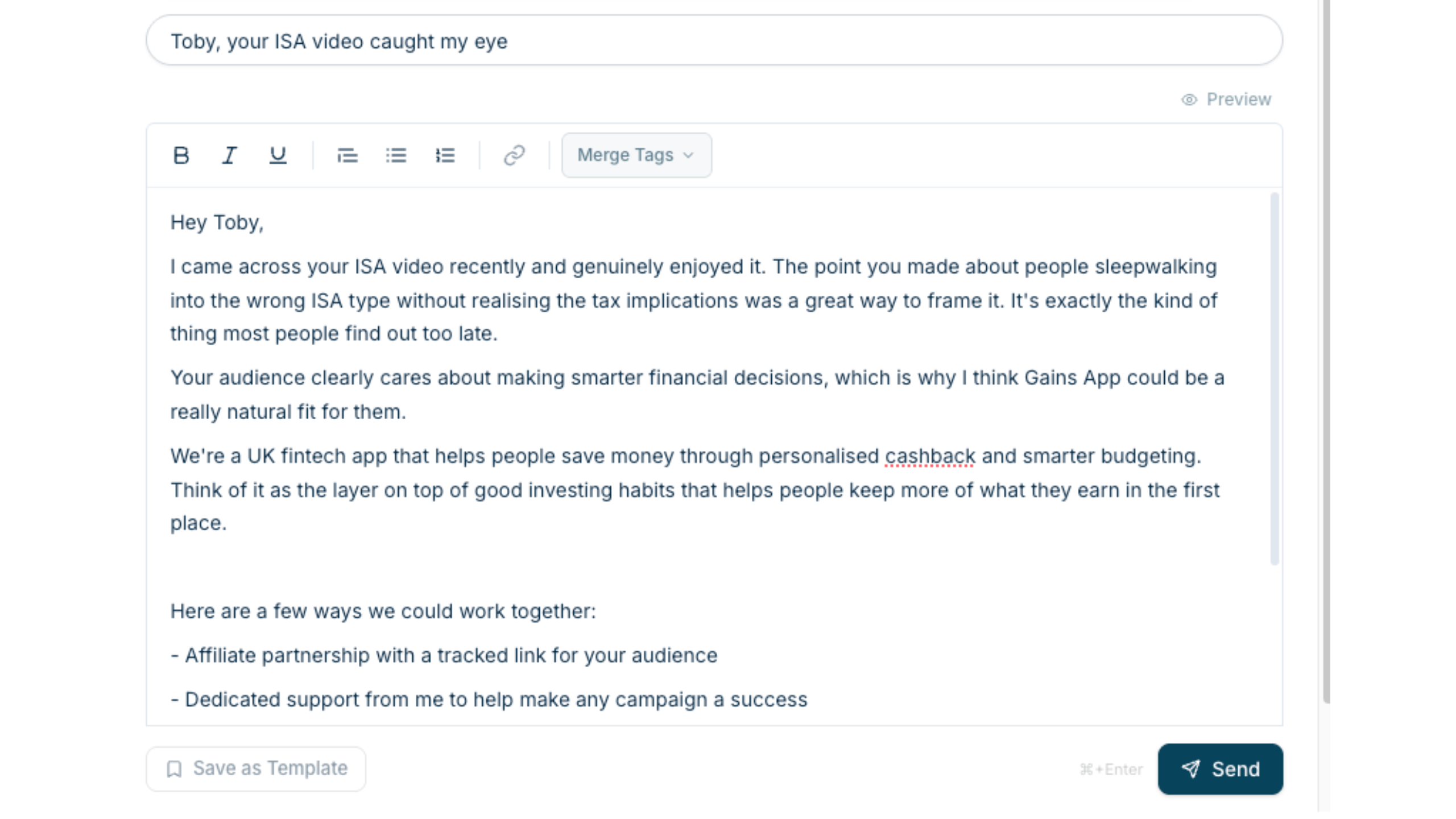
Then reach out in one click within the AffiliateFinder inbox area, using the AI email generation to send hyper-personalized emails based on the AI's deep dive of their content.
I personally used to spend hours hunting down good affiliates, scrolling manually through the blogs, using SEO tools to reverse-engineer affiliate backlinks, and a lot more.
So we spent the last 2 years turning all our tricks into the ultimate affiliate competitor intelligence system, and released it as AffiliateFinder.
It is the fastest way to reverse-engineer your competitors' affiliate programs and see who is actively promoting them.
And from there, you can email them directly within AffiliateFinder to recruit them as your affiliate instead.
This saves you potentially days of manual researching — with AffiliateFinder, you can find, prospect and contact these affiliates within 10-15 minutes, instead of days.
Once you've started reaching out and getting replies, you can manage your affiliate recruitment process in the AffiliateFinder CRM — that we call your "Recruitment Pipeline".

Your Recruitment Pipeline automatically updates when any affiliate replies — so you don't need to manually update any spreadsheet. And it'll remind you to follow up if you haven't heard back in a while — so you can pick up deals before they go cold.
If you're looking to find your competitors' top affiliates and recruit them, using AffiliateFinder is the best way to do this at scale.
There's a 7-day free trial — so you can test it out before committing. From there, plans start at $69/month.
2. Search Google for Content Websites Promoting Your Competitors
One of the best ways to find affiliates is still searching Google to find the bloggers and content websites.
And: recruiting content websites as affiliates is one of the most effective ways to grow your AI visibility now. Your affiliate program is now about more than just revenue: it's an AI visibility engine.
Many affiliate publishers create content like product reviews, comparison articles, and "best of" lists. These pages are specifically designed to rank in search results and convert readers into buyers through affiliate links.
Try searching for queries such as:
- "[competitor] review"
- "[competitor] vs"
- "[competitor] alternatives"
- "best [product category]"
And to find coupon or cashback websites:
- "[competitor] discount code/coupon code"
- "[competitor] cashback"
Then, click into the websites ranking on the first page (or top 20 if you want to go deeper), and see which are affiliates.
Signs that they are affiliates include disclosure statements, "pretty links" to hide the affiliate link (or a clear affiliate tracking ID in the link).
These affiliates that already rank on the first page of Google are incredibly valuable affiliates. They're already ranking and driving stable traffic every day. These are the types of partners that will send clicks for months or years to come — and you just have to recruit them once.
This method is free — but time-consuming.
If you're an AffiliateFinder customer, the software does this all for you automatically. AffiliateFinder automatically searches for all relevant competitor keywords and finds the active affiliates for you.
3. Analyse Competitor Backlinks with SEO Tools
Especially for website publishers, using SEO tools to reverse-engineer the affiliate backlinks a competitor has is incredibly powerful.
You can use SEO backlink tools, like Ahrefs or SEMrush, to find all of these affiliate links from these promoting websites.
How to do it:
- Enter your competitor's domain into your SEO tool
- Go to the backlinks or "Referring Domains" report
- Look for links that contain affiliate parameters
- Filter by traffic to prioritise high-value affiliates
Here's an example for a well-known SaaS, which uses the referral tag "?ref=" - so I was able to isolate 712 websites linking them to an affiliate link by using the "Target URL contains" filter and adding their referral code:

Note: this is harder for some brands than others. Some affiliate networks use more obscure tracking ID parameters which can be harder to find.
So here's a list of a few examples to help you (if your competitor is on one of these networks, just use these):
- CJ Affiliate (Commission Junction): anrdoezrs.net, dpbolvw.net, jdoqocy.com, tkqlhce.com, kqzyfj.com
- Impact: sjv.io, pxf.io
- Rakuten / LinkShare: click.linksynergy.com
- Awin: awin1.com, zenaps.com
If you already have Ahrefs or Semrush, then using this gets you a good target list of websites to outreach and recruit.
The downside? If you don't have these tools already, they're expensive — usually $130+ per month.
If you don't want to do this manual research to find the right affiliate network code, and you want to save money, you can use our AffiliateFinder.ai software to do this for you.
We automatically find all the affiliates linking to your competitors within our affiliate search scan. We track 150+ affiliate networks 24/7, so you'll find all the affiliate websites linking to your competitors when you sign up.
And, we filter out the non-affiliate backlinks, so you don't have to spend time finding what the affiliate referral code for that particular competitor is, to isolate that in your SEO tool.
We also find the verified email addresses for 90%+ of affiliate websites, and you can reach out to those websites at scale within AffiliateFinder — just integrate your email inbox.
And, we're cheaper than standalone SEO tools, too. AffiliateFinder starts at $69/month, which is a lower price than Ahrefs or Semrush.
4. Find Your Competitors' YouTube Affiliates
YouTube has become one of the largest affiliate channels, particularly for product reviews and tutorials.
Creators frequently include affiliate links in their video descriptions or give them promo codes, directing viewers to the products they recommend.
Start by searching YouTube for queries like:
- "[competitor] review"
- "[competitor] tutorial"
- "[competitor] vs [competitor]"
- "best [product category] 2026"
- "[competitor] alternatives"
When reviewing videos, check the description section for affiliate links, promo codes, or affiliate disclosures.
If you're an AffiliateFinder user, we already scan the YouTube video descriptions for every product reviewer, tutorial creator, and comparison video affiliate to find affiliate links.
So, if you want to save all the manual time scrolling through YouTube to find the active affiliates in your niche, you can just sign up for our 7-day free trial and try it for yourself.
We also find 90%+ of YouTuber emails so you can reach out and recruit them to review you.
And if you've tried to get a YouTuber's email before, you'll know you have to complete a 2-minute Captcha every…single…time.

So if you don't want to spend an hour every day telling YouTube which of these 3 boxes is a zebra crossing — then you don't have to if you're an AffiliateFinder customer. We find all those emails for you, even if you want to find hundreds of them at a time.
AND: method #2 for finding YouTuber affiliates linking to your competitors
You can also use an SEO tool like Ahrefs to find YouTubers.
The trick is to find all the backlinks to your competitors, and then filter them from JUST youtube.com. Here's an example for a large SaaS, which has 406 backlinks from different YouTube videos, who are all potential affiliates of yours if you run a competitor:

This isolates all the links from YouTube to your competitors - and can surface some videos you might not have found from a manual search.
Again, AffiliateFinder does this for you automatically, so you don't need to pay for an SEO tool like Ahrefs or SEMrush if you're already a customer of ours. We'll find all these YouTuber affiliates for you.
For more information, I have an even more in-depth guide to finding YouTube affiliates.
5. Monitor Social Media Mentions
A lot of affiliate activity happens on social platforms — especially Instagram, TikTok, and Twitter (X).
To find them, search for your competitor's brand name or related hashtags. Look for posts where creators are recommending the product, demonstrating it, or sharing their experience.
Search branded hashtags:
- #[competitorname]
- #[competitorname] review
- #[competitorname] partner
Look for disclosure hashtags:
- #ad
- #sponsored
- #affiliate
- #gifted
On Instagram, search the competitor's brand name and filter by "Tags" and "Recent." You'll find posts from creators who are tagging the brand — many of whom are affiliates or ambassadors.
On TikTok, search for the competitor name and look for videos with affiliate disclaimers in the caption or comments — or clear TikTok Shop CTAs.
The challenge with social monitoring is volume. Popular competitors might have thousands of mentions, and most won't be affiliates. You'll spend time filtering through noise.
This is another area where AffiliateFinder.ai adds value — if you add your competitors in, we'll find the exact mentions, and prioritise the ones with strong signals that they are active affiliates.
AffiliateFinder tracks competitor mentions across Instagram and TikTok for you — so you're covered across all major platforms.
6. Use Referral Traffic Analysis
Referral traffic tools can reveal which websites are sending visitors to your competitors.
Platforms like SimilarWeb provide reports showing the domains that drive traffic to a specific website. Many of these referral sources are affiliate publishers.
To use this method:
- Enter a competitor's domain into SimilarWeb.
- Navigate to the "Referrals" or "Incoming Traffic" section.
- Review the list of referring websites.
You'll often find review sites, comparison platforms, and niche blogs that link to competitor products. These sites are strong candidates for affiliate partnerships.
SimilarWeb can be quite expensive though, so it depends on your budget.
7. Explore Affiliate Networks Directly
If your competitors use the same affiliate network as you, you can sometimes find their affiliates within this network.
Major networks include:
- CJ Affiliate (Commission Junction)
- Impact
- Rakuten Advertising
- TradeDoubler
- Awin
- PartnerStack
Some networks provide directories or marketplace features where you can see publishers promoting products within certain categories.
Even when specific affiliates are not publicly visible, joining the same network allows you to appear in front of affiliates who are already promoting similar products.
For example, if a lot of your competitors are on the same network, then if you did decide to join this network also, you'd be able to approach all the relevant publishers on that network to become an affiliate of yours as well.
However, the prices for joining these networks vary, but expect to pay $500+ per month for a serious network, as well as commissions on your earnings.
8. Finding the Paid Ads Affiliates
If you have an affiliate offer good enough to make paid ads affiliates work, then this is probably the most profitable area to focus on. Offer owners in big-money niches like finance, weight loss and supplements have created $100M+/year companies from affiliate traffic.
Media buying affiliates are some of the most skilled affiliates out there. It's their own money on the line, so you need a proven offer that converts or a generous test budget to get them onboarded, but the returns can be incredible if this works.
It's more difficult to directly find these affiliates promoting competitors, but here are some tips:
Google Ads Transparency Center (the big one)
Go to adstransparency.google.com and search any advertiser — a competitor, a known affiliate site, or a review domain you've seen in the wild.
You'll get every ad they've run across Google Search, Display, and YouTube, along with the landing pages. This is the single most powerful free tool for reverse-engineering paid affiliate activity.
Workflow:
- Search your top competitors' brand names to find affiliates bidding on them
- Search generic category terms ("best CRM," "top protein powder") and follow the ads back to review/comparison sites
- Note the domains that show up repeatedly — those are your target affiliates
Facebook Ad Library
Go to facebook.com/ads/library and set the country + category. The Meta Ad Library is organized by Page, not by ad content, so searching your brand name mostly returns your own ads.
Instead:
- Search suspected affiliate Page names directly (e.g., "Best Supplements Reviewed," "Honest Product Reviews")
- Use the keyword filter within ad creative — imperfect but catches some affiliates running comparison copy
- Filter by advertiser country and category to narrow the pool
Paid intelligence tools
If you're serious about this channel, invest in a spy tool. These are built specifically to index paid affiliate campaigns:
- AdPlexity — strong for native and mobile affiliate campaigns
- AdSpy / BigSpy — Facebook and Instagram coverage
- SimilarWeb or SEMrush — shows which URLs competitors' paid traffic lands on, exposing affiliate review pages
Native ad networks
Don't sleep on native ads, honestly. Taboola and Outbrain are massive channels for finance, supplement, and health affiliates, and most brands overlook them.
Both have their own ad libraries (Taboola Trends, Outbrain's insights tool) you can dig through.
What you're looking for
Regardless of the tool, your targets are the same:
- Comparison sites running ads ("best [category]")
- Review sites targeting competitor brand names
- Coupon and deal sites advertising competitor products
- Ads that land on review pages, roundups, or comparison articles — not directly on a brand site
Any affiliate running paid campaigns has already proven they can generate profitable traffic. That's a massive pre-qualification.
Once you've found them, reach out with your offer terms, your EPC data, and a test budget if relevant.
9. Find Affiliates in Niche Forums and Communities
Affiliates talk to each other. Finding where those conversations happen can reveal exactly who's promoting what.
Places to explore include:
- Reddit communities like r/AffiliateMarketing or niche-specific subreddits
- Affiliate marketing forums such as AffiliateFix or Warrior Forum
- Facebook groups focused on blogging, creators, or affiliate marketing
The upside of forum research is context. You learn why affiliates choose certain programs, what they value, and what frustrates them. This informs both your recruitment pitch and your program structure.
The downside is that it's manual and time-consuming. But for understanding affiliate mindset, it's invaluable.
It's also not ideal for finding a specific brand's affiliates — since there usually isn't public groups for specific affiliates.
BUT: some large brands DO have Facebook Groups or similar communities for their affiliates. If these exist, you can literally join them and see who is promoting them.
10. Set Up Ongoing Monitoring (Google Alerts + Social)
Affiliate discovery shouldn't be a one-time activity.
New affiliates are constantly starting up, creating content, and promoting brands like yours (or your competitors).
Setting up monitoring tools ensures you continue discovering new opportunities over time.
Google Alerts allows you to track mentions of competitor brand names — not just your own.
You can also monitor social media mentions and hashtags related to competitors.
By checking these alerts regularly, you can quickly identify new affiliates as they start promoting products in your category.
The downside is you'll pick up a lot of noise, for example press releases that are not affiliates. But, some will be affiliates.
If you're an AffiliateFinder customer, we'll automatically find these new brand mentions of competitors for you every week, so it does this for you.
What to Do After Finding Competitors' Affiliates
Finding affiliates is only half the battle.
Well, honestly, it's less than half the battle.
Now you've got to convince them it's a no-brainer for them to promote you — and activate them so they create content/run ads to send you sales.
Here's how to turn your competitor affiliate research into recruited affiliates in your program.
1 — Organize Your Prospects
At a minimum, you'll want to track:
- Affiliate name/website
- Platform (blog, YouTube, Instagram, etc.)
- Contact info (email, social handles)
- Estimated reach/traffic
- Content they've created for competitors
- Notes on why they'd be a good fit
Many teams start by managing this in a spreadsheet. This allows you to prioritise the highest-value opportunities first. For example, a blog with 100,000 monthly visitors or a YouTube channel producing in-depth reviews gets more attention than a smaller creator.
However, managing affiliate recruitment in spreadsheets becomes DIFFICULT once your list balloons to 200+ affiliate leads.
I've been there: especially if you forget to update a few affiliate replies, and all of a sudden you've lost track of a lot of in-progress relationships, which can ruin deals.
We built the AffiliateFinder CRM specifically to handle this. It's a kanban board with all your affiliates and each stage of the deal process they're at.
And it automatically updates when an affiliate replies, so you don't need to manually track conversations.

This makes it much easier to manage hundreds of outreach conversations without losing track of where each prospect is in the recruitment process.
2 — Write Outreach Emails That Get Replies
Generic emails get ignored. Trust me, the affiliates and influencers you want to work with are getting bombarded by 50+ SLOP emails every day.
How to stand out amongst the noise? Do better than them.
After 7+ years in affiliate recruitment and having sent well over a million emails to affiliates across dozens of programs, we've condensed what actually works into the RWOR framework:
- Reason — Why you're reaching out today and how you found them. "I just watched your review of [competitor] and loved [specific thing they said]" beats "I came across your channel" every single time.
- Why — Why you should work together. Who you are, what your product does, and the social proof that makes it credible (customer count, notable customers, results other affiliates have seen).
- Offer — What you're putting on the table. Commission, free access, a test budget, custom landing pages, content support — whatever makes it a no-brainer for them to say yes.
- Reply — A reply-bait CTA. The goal of the first email is NOT to close them. It's to get any response at all. Once they reply, the deal is open.
.png)
Good reply-bait looks like:
- "Can I set you up with a free account to test it out — just say 'yes'?"
- "Where's best to send the free samples — would [product A and B] work?"
- "Would a 10-min call next week at [time] work? — here's my calendar for any other times"
Make the ask low-friction they can answer with a single word or within 10 seconds of their time, to get the deal started.
How AffiliateFinder does this for you:
We've built the entire RWOR framework into AffiliateFinder's AI email generator.
You pick your outreach type, and our AI agent:
- Reads their blog posts
- Pulls transcripts from their videos
- Analyzes their recent content
- Writes a hyper-personalized email using the RWOR structure
The output feels like you deep-dived them for 4 hours before writing the email. At scale. Across thousands of affiliates.
That's how you get replies without burning a full-time recruiter's week on research.
Two more things that move the needle more than people expect:
1 — Send 4-5 emails, not one.
From all the campaigns we've run to recruit affiliates, more than 40% of total responses have come from follow-ups — NOT the first email.
If you're sending one email and giving up, you're leaving nearly half your potential affiliates on the table.
2 — Vary the personality across the sequence.
Every person has a different personality. Some love fun GIFs, flowery language and emojis, some are very business business business. Everyone responds differently to different angles and styles.
But, if you're sending 200+ emails per week to influencers, it's obviously not possible to study all 200 affiliates to understand exactly the best approach and angle.
What you can do instead, is have a standard set of templates for your 4 or 5 email sequence, and then just vary the personality used across each one.
The more you vary this, the more likely you are to strike a chord with the particular person you're sending to.
Think of it like optimising your Tinder profile. You COULD dumb down all your weird quirks and be a 5/10 for everyone — or just play it up and go niche, and be the dream match for a specific type of person.
You're basically doing this across each of the 4 or 5 touch points you have with the affiliate. One can be more formal for the partnership focusing on social proof, one more casual, one more sponsorship-focused, one that fangirls them about a specific piece of content they did.
You're not writing one email five times. You're giving them five different reasons to reply.
3 — Highlight Your Competitive Advantages
Affiliates already promoting competitors will compare programs.
Give them reasons to switch or add you:
- Higher commission rates
- Longer cookie duration
- Better conversion rates and EPC (provide data if you have it)
- Superior promotional materials
- Faster payouts
- Better affiliate support
- Products their audience will love
- Test budget (for paid ads affiliates)
Make it as easy as possible for them to get involved. This is the "R" in RWOR - make it so easy that they just need to say "yes" and you'll get them sorted.
Whether that's instant free access to your SaaS to test it out for a review, or sending them free products to show in a TikTok, or anything else - just make it super easy to get the first "yes" and get the deal process started.
Now in 2026, this is table-stakes for getting affiliate partners activated.
Remember: creators with big audiences are getting 50+ messages a week from brands now trying to give them free stuff and work with them. You need to stand out, and make it super easy for them — or they'll just ignore it.
Putting It All Together
Finding competitors' affiliates isn't complicated…most brands just never do the research.
Instead, they launch an affiliate program, add it to their website, and hope affiliates just magically discover them. Trust me, that approach doesn't work — it just slows your affiliate growth massively.
The fastest way to grow an affiliate program is to recruit creators who are already promoting products like yours.
These affiliates:
- Understand your niche
- Have audiences interested in your products
- Already know how to create content that converts
Your job is simply to find them and give them a compelling reason to promote you as well.
Here's a practical way to approach it depending on your situation.
If you want speed and scale:
Consider trying AffiliateFinder.ai.
We have a 7-day free trial, so if you absolutely hate it, just use it for 6 days and cancel.
We'll instantly surface hundreds of affiliates promoting your direct competitors, across Google, YouTube, TikTok, Instagram, and more. We've been ranked the number 1 best affiliate recruitment software by numerous industry experts.
We used to spend 15-20 hours per week scrolling through pages and pages of results trying to find affiliates - so we built AffiliateFinder to solve our own problem.
Those hours are valuable. Save them - and use a tool like ours instead, so you can use your time on the valuable parts like building those close affiliate relationships that help scale your revenue.

Find, contact, and close affiliate partners — from one dashboard
AffiliateFinder surfaces affiliate-ready creators and content sites across websites, YouTube, TikTok, and Instagram — with verified emails for 91%+ of them.


